

Quick Definition #
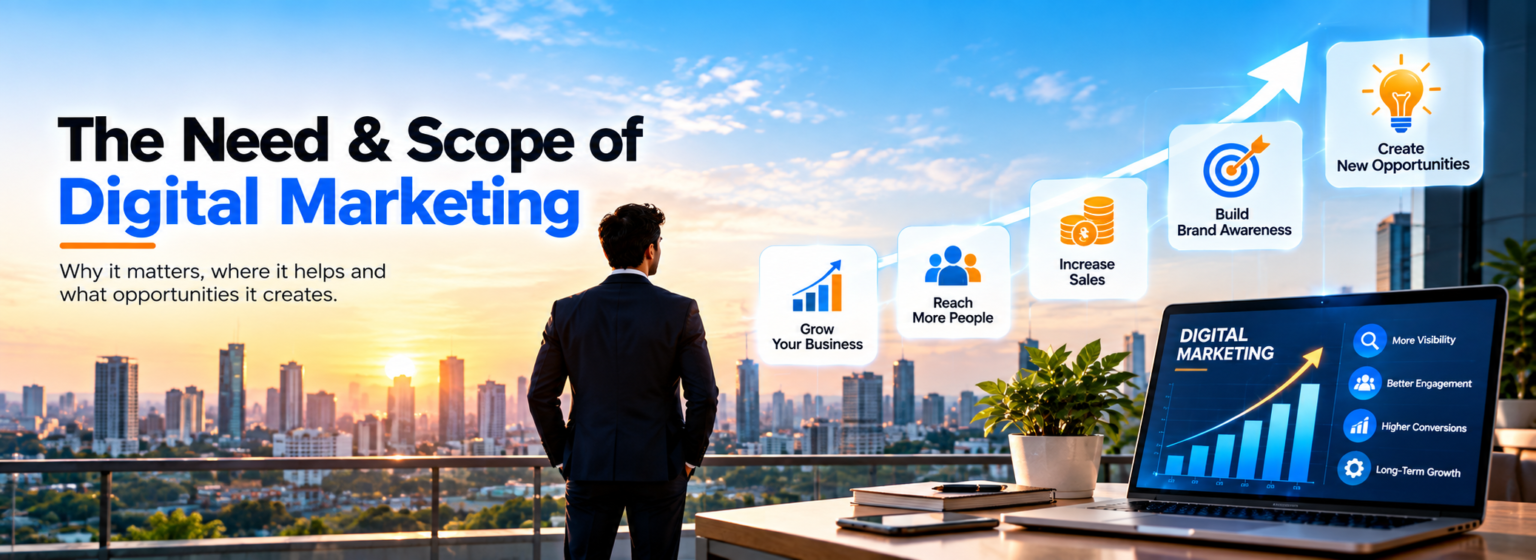
Need and Scope of Digital Marketing refers to why organisations use digital channels to reach, engage, convert and retain customers, and the broad range of activities, platforms, technologies, roles and business applications included within digital marketing.
Digital marketing is no longer limited to online advertising or social media. It can influence almost every stage of the customer journey—from discovering a brand and researching a product to making a purchase, receiving support and becoming a repeat customer.
In Simple Words #
A business needs digital marketing because customers increasingly use digital environments to find information, compare choices, communicate with businesses and make decisions.
For example, a person looking for an interior designer may:
- Search Google for local designers.
- Visit a website and review previous projects.
- Check Instagram for visual examples.
- Read reviews.
- Submit an enquiry through a form or WhatsApp.
- Receive a follow-up message.
- Compare quotations before making a decision.
Digital marketing provides the channels and processes that allow a business to participate in those interactions.
Why Businesses Need Digital Marketing #
1. Customers Are Digitally Connected #
Customers use search engines, websites, social platforms, email, messaging applications, video platforms and mobile devices throughout the buying process.
A business that understands these touchpoints can design its marketing around actual customer behaviour rather than relying only on traditional promotional methods.
2. Customers Research Before Buying #
Digital channels allow customers to research products, services, prices, features, alternatives and reviews before contacting a business.
This makes discoverability, useful content, trust signals and a strong digital presence important parts of modern marketing.
3. Businesses Need Measurable Marketing #
Digital channels can provide data about impressions, traffic, clicks, engagement, leads, conversions, costs and revenue-related outcomes.
This allows marketers to evaluate activities and make informed optimisation decisions.
4. Competition Has Moved Online #
Competitors can appear in search results, social feeds, marketplaces, advertising platforms and other digital environments.
Digital marketing helps organisations compete for relevant attention where their audiences are already active.
5. Businesses Need Continuous Customer Relationships #
Marketing does not necessarily end after a transaction. Email, content, social media, CRM systems, messaging and remarketing can support retention and repeat engagement where appropriate.
6. Businesses Can Reach Beyond Physical Locations #
A digital presence can allow organisations to reach customers outside their immediate physical area, subject to the product, service, market and distribution model.
Scope of Digital Marketing #
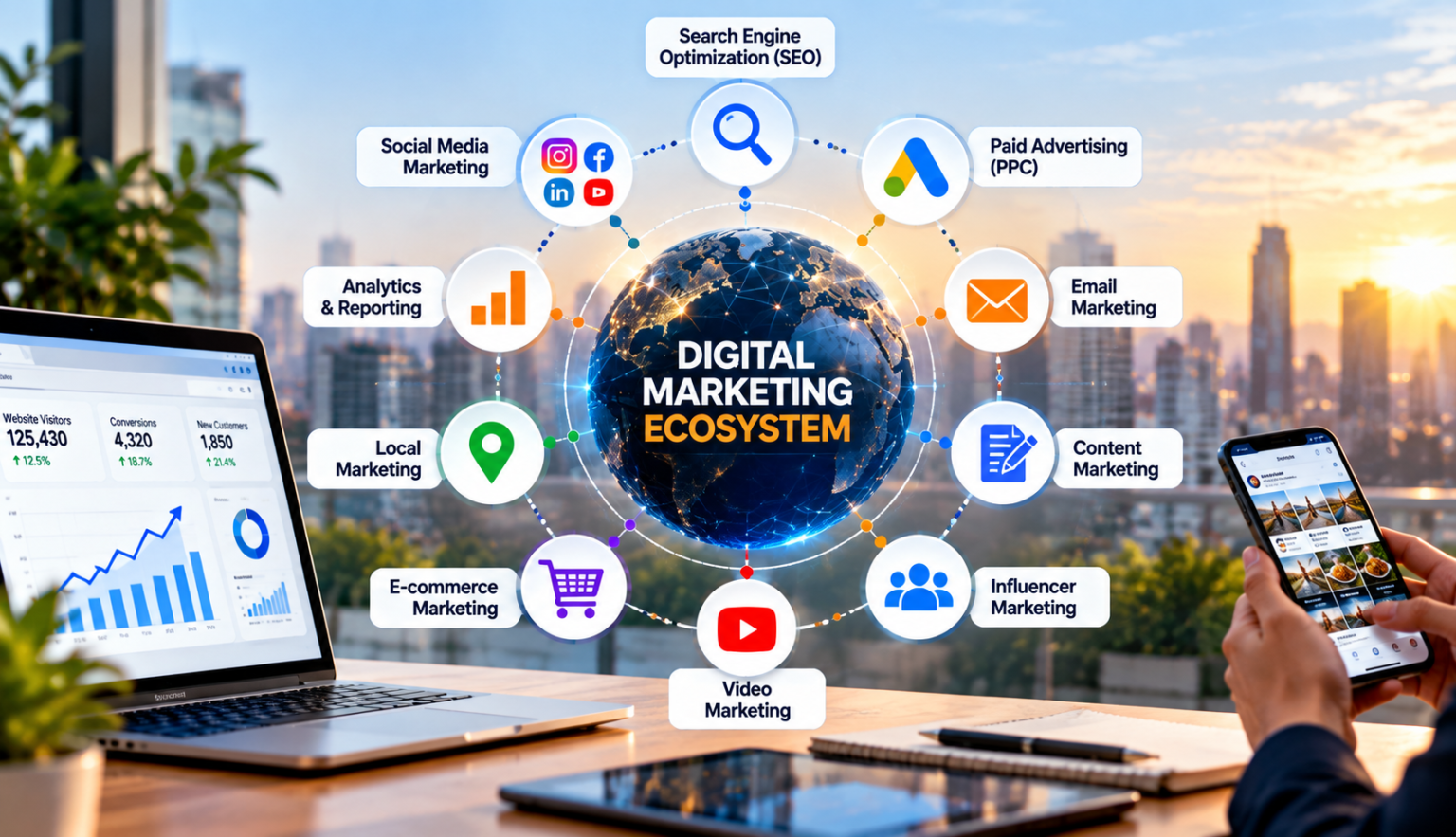
The scope of digital marketing is broad. It includes strategic planning, customer research, channel management, content, advertising, technology, analytics and optimisation.
Search Engine Optimization (SEO) #
SEO improves the visibility of relevant web content in organic search results.
It includes:
- Keyword and search-intent research
- Technical SEO
- On-page optimisation
- Content optimisation
- Internal linking
- Local SEO
- Link acquisition and digital PR
- Search performance measurement
Pay-Per-Click and Online Advertising #
Paid digital advertising can place messages in front of selected audiences through search, display, shopping, video, social and other advertising environments.
Activities include:
- Campaign planning
- Audience targeting
- Keyword selection
- Ad creation
- Budget management
- Bidding
- Landing-page optimisation
- Conversion tracking
- Performance optimisation
Social Media Marketing #
Social media marketing uses platforms to distribute content, build communities, engage audiences and support marketing objectives.
It may include:
- Organic social media
- Paid social advertising
- Community management
- Influencer marketing
- User-generated content
- Social listening
- Social analytics
Content Marketing #
Content marketing focuses on creating useful and relevant material for a defined audience.
Examples include:
- Blog articles
- Guides
- Videos
- Infographics
- Case studies
- Podcasts
- Social content
- Educational resources
Email Marketing #
Email marketing supports communication with people who have opted into an organisation’s email list.
Common applications include newsletters, welcome sequences, promotional campaigns, lead nurturing, customer communication and automation.
Website and Conversion Rate Optimization #
A website often acts as a central digital destination.
Digital marketing therefore includes:
- Website strategy
- Landing pages
- User experience
- Conversion-focused design
- Calls to action
- Lead forms
- A/B testing
- Conversion Rate Optimization (CRO)
Analytics and Measurement #
Analytics connects marketing activity with measurable behaviour.
Marketers may analyse:
- Traffic sources
- Users and sessions
- Engagement
- Conversions
- Conversion rate
- Customer acquisition cost
- Return on ad spend
- Customer lifetime value
- Campaign performance
Mobile Marketing #
Mobile marketing covers marketing experiences delivered through mobile devices.
Examples include mobile-optimised websites, apps, SMS, messaging, location-based experiences and mobile advertising.
Video Marketing #
Video can be used for awareness, education, demonstrations, product explanations, testimonials, entertainment and conversion support.
Affiliate Marketing #
Affiliate marketing uses external partners who promote products or services and may receive compensation based on agreed actions such as sales or leads.
Influencer and Creator Marketing #
Businesses can collaborate with creators whose audiences are relevant to the campaign objective. Activities may include sponsored content, product demonstrations, reviews and creator-led campaigns.
Online Public Relations and Digital PR #
Digital PR uses online publications, media relationships, expert commentary, digital assets and other activities to build awareness, credibility and earned exposure.
Marketing Automation and CRM #
Technology can help businesses manage leads, customer information, communication workflows, segmentation and personalised experiences.
AI and Emerging Technologies #
Digital marketing increasingly includes applications of artificial intelligence and automation for areas such as research, content assistance, customer analysis, personalisation, advertising optimisation and predictive analytics.
AI does not remove the need for strategy, human judgement, verification, privacy considerations or quality control.
Scope Across the Customer Journey #
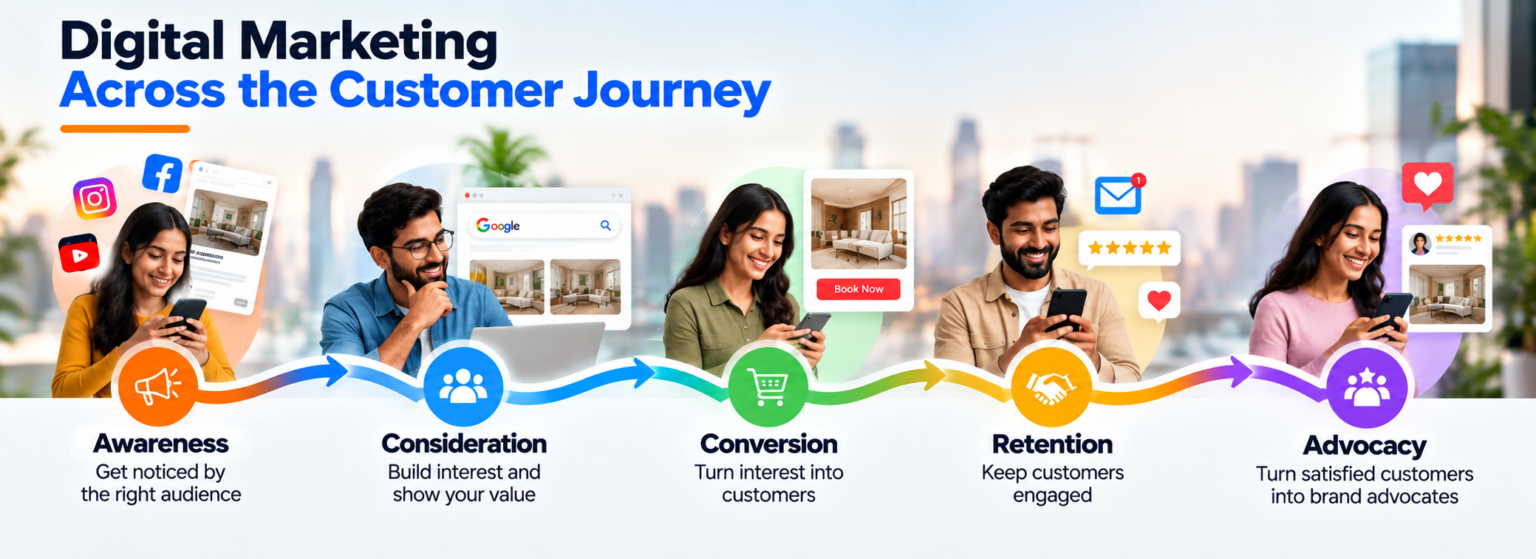
Digital marketing can support different stages of the customer journey:
| Stage | Possible digital activities |
|---|---|
| Awareness | SEO, social media, video, display advertising, digital PR |
| Consideration | Blogs, guides, reviews, comparison content, webinars |
| Conversion | Landing pages, PPC, product pages, forms, offers |
| Retention | Email, CRM, messaging, useful content, loyalty communication |
| Advocacy | Reviews, referrals, communities, user-generated content |
The exact channel mix depends on the audience, product, business model, objective and available resources.
Scope Across Business Functions #
Digital marketing also connects with several business functions.
Sales #
Marketing can generate and nurture leads that are passed to sales teams.
Customer Service #
Websites, social platforms, email and messaging can support customer communication and service.
Product Management #
Customer behaviour, search trends, reviews and feedback can provide useful market information.
Human Resources #
Organisations also use digital channels for employer branding, recruitment communication and talent attraction.
Management #
Dashboards and marketing reports can help management evaluate performance, budgets and business outcomes.
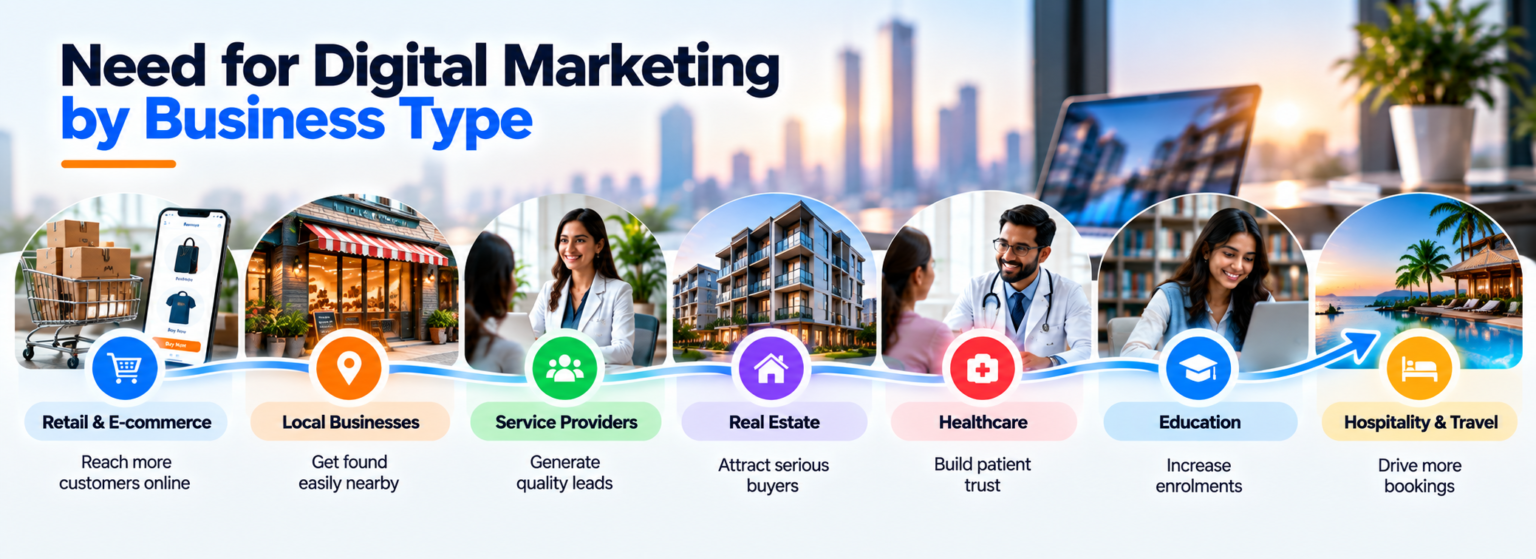
Need for Digital Marketing by Business Type #
B2C Businesses #
Consumer businesses may use digital marketing for product discovery, online sales, local visibility, customer engagement and retention.
B2B Businesses #
B2B organisations may use digital marketing for demand generation, lead generation, thought leadership, account-based activities and sales enablement.
Local Businesses #
Restaurants, clinics, interior designers, educational institutions and other local businesses can use local SEO, social media, reviews, websites, paid advertising and messaging to reach nearby customers.
E-commerce Businesses #
E-commerce companies often depend heavily on product discovery, search, paid advertising, content, social commerce, email, remarketing and conversion optimisation.
Startups #
Startups can use digital channels to build awareness, test positioning, acquire early users and gather market feedback.
Digital Marketing as an Integrated System #
The scope becomes clearer when digital marketing is viewed as an interconnected system rather than a list of separate services.
For example:
SEO → Website → Content → Lead Form → CRM → Email/Follow-up → Conversion → Analytics
Social media and paid advertising may introduce people to the content or website. Analytics can then show which activities contribute to the desired outcome.
The role of a marketer is therefore not simply to operate individual platforms, but to understand how channels work together.
Factors That Determine the Scope #
The scope of digital marketing is not identical for every organisation. It depends on:
- Target audience
- Business model
- Product or service
- Customer journey
- Geographic market
- Marketing objectives
- Competition
- Budget
- Available skills and technology
- Regulatory and privacy requirements
- Measurement capabilities
A small local service business may need a focused combination of local SEO, a website, social media and lead generation. A global e-commerce company may require a much larger system covering SEO, paid media, marketplaces, CRM, email, analytics, automation and experimentation.
Benefits of Understanding the Scope #
Understanding the full scope helps marketers:
- Select channels based on objectives rather than trends.
- Avoid treating social media as the entire digital marketing function.
- Connect marketing activities across the customer journey.
- Identify suitable metrics for different activities.
- Allocate resources more logically.
- Understand how technology supports marketing.
- Build integrated digital marketing plans.
Limitations and Considerations #
Digital marketing is powerful, but it is not automatically effective.
Important considerations include:
- Digital audiences can be highly competitive.
- Advertising costs vary by market and audience.
- Platform algorithms and features change.
- Privacy rules affect data collection and targeting.
- Attribution across multiple channels can be difficult.
- Poor content or user experience can reduce performance.
- More traffic does not necessarily mean more customers.
- Automation without appropriate strategy can create poor experiences.
Digital marketing should therefore be treated as a business discipline rather than simply a collection of online tools.
Real-World Example: Local Interior Design Business #
Suppose an interior design company wants to generate qualified enquiries from homeowners in its service area.
A possible digital marketing system could include:
- Local SEO: Improve visibility for relevant local searches.
- Website: Present services, projects, testimonials and enquiry options.
- Content: Publish useful articles about design, budgets and renovation planning.
- Instagram: Showcase completed projects and visual ideas.
- Paid Ads: Reach relevant audiences and searchers with high purchase intent.
- Lead Forms: Capture enquiry details.
- WhatsApp or Email: Follow up with prospects.
- Analytics: Measure traffic, enquiries, conversion rate and acquisition costs.
- CRM: Organise and follow up with leads.
The scope is therefore broader than “posting on Instagram.” Each activity has a specific role within the overall customer acquisition system.
Practical Exercise #
Choose a real or imaginary business and answer the following:
- Who is its target audience?
- What problem or need does it solve?
- How might customers discover the business online?
- Which three digital channels would you consider?
- What role would each channel play?
- What would the primary conversion be?
- Which KPIs would you track?
- How would you retain customers after the first transaction?
Extension Exercise #
Create a simple table with four columns:
Customer Stage | Channel | Activity | KPI
Fill it for Awareness, Consideration, Conversion and Retention.
Interview and Exam Questions #
Beginner #
- Why is digital marketing needed by modern businesses?
- What is the scope of digital marketing?
- Why is digital marketing broader than social media marketing?
- Name five major areas of digital marketing.
- How does digital marketing support customer acquisition?
Intermediate #
- Explain the scope of digital marketing with examples.
- How does digital marketing support different stages of the customer journey?
- Explain how SEO, content marketing and PPC can work together.
- What factors determine the digital marketing channel mix?
- Explain the role of analytics in digital marketing.
Practical Case #
A local business has a good product but receives very few online enquiries. Which areas of digital marketing would you investigate first?
Consider its search visibility, website experience, content, social presence, advertising, targeting, calls to action, lead forms, customer reviews and measurement setup before recommending specific changes.
Quick Revision #
- Digital marketing is needed because customers increasingly use digital channels throughout the buying journey.
- Its scope extends far beyond social media and online advertising.
- Major areas include SEO, PPC, social media, content, email, websites, CRO, analytics, mobile, video, affiliate marketing, digital PR, CRM, automation and emerging technologies.
- Digital marketing can support awareness, consideration, conversion, retention and advocacy.
- The appropriate channel mix depends on the audience, business model, objective, market and resources.
- Digital marketing connects with sales, customer service, product management and other business functions.
- Measurement and optimisation are essential parts of the discipline.
- Effective digital marketing is an integrated system rather than a collection of isolated platforms.
Related Topics / Next Lessons #
Continue the Fundamentals path with:
- Traditional Marketing vs Digital Marketing
- Evolution of Digital Marketing
- Digital Marketing Ecosystem
- Components of Digital Marketing
- Digital Marketing Channels
- Digital Marketing Platforms
- Owned, Earned & Paid Media
- Benefits of Digital Marketing
Key Takeaway #
The need for digital marketing comes from changes in customer behaviour, competition, communication and measurement. Its scope covers the strategies, channels, technologies and processes used to attract, engage, convert and retain audiences in digital environments.
A strong digital marketer understands not only how individual channels work, but also why a channel is being used, where it fits in the customer journey, how it connects with other channels and how its contribution can be measured.


