

Quick Definition #
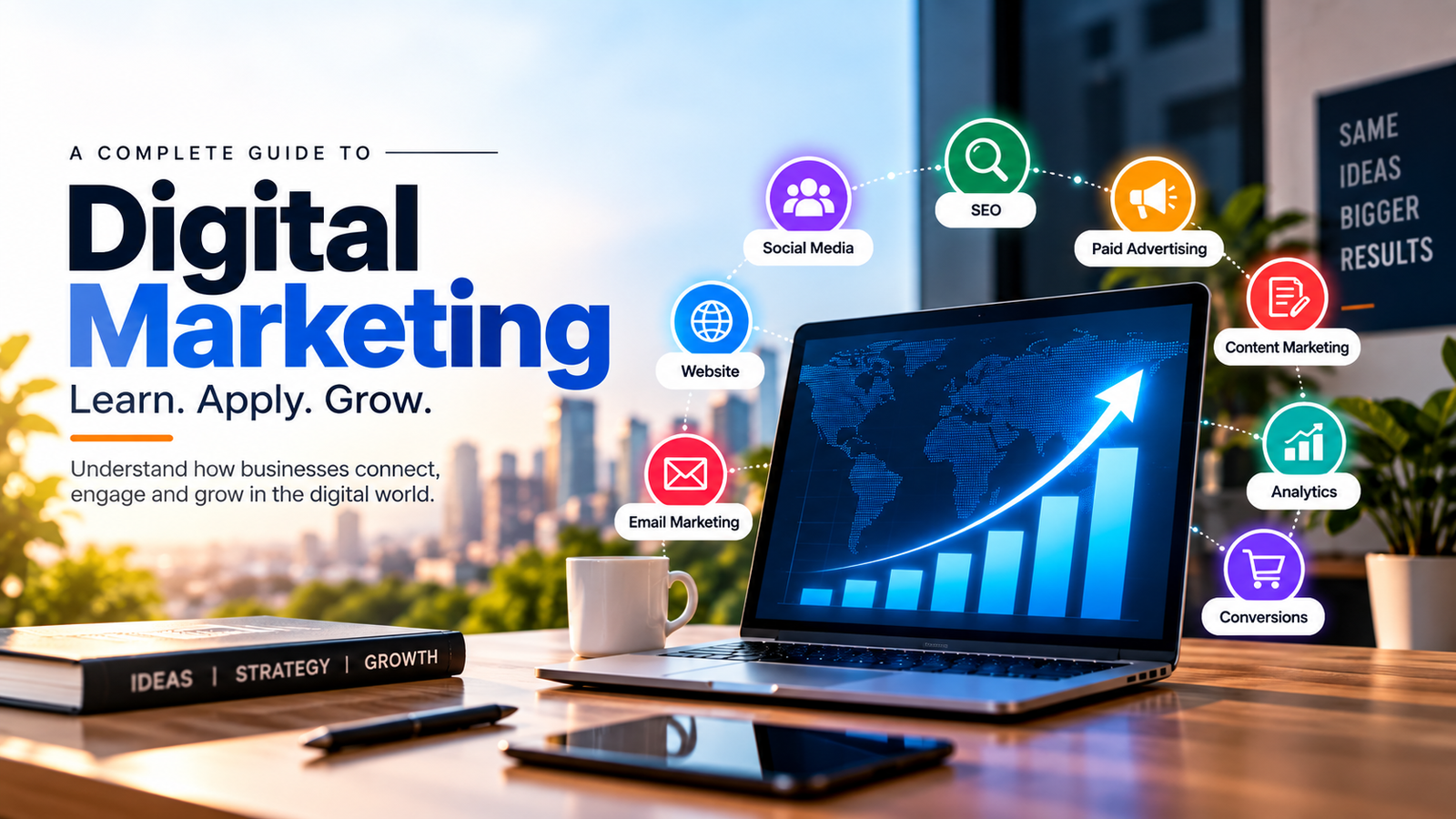
Digital marketing is the use of digital channels, platforms, technologies and data to promote products, services, brands or ideas, attract relevant audiences, generate desired actions and build customer relationships.
In simple terms, it is marketing in digital environments—through websites, search engines, social media, email, online advertising, mobile platforms, content and other connected channels.
Digital marketing is much broader than social media posting or online advertising. It is a coordinated system in which different channels can work together across the customer journey.
In Simple Words #
Imagine a local interior design company wants more enquiries.
It could:
- Build a website that explains its services and showcases completed projects.
- Use SEO so people searching for interior designers can discover the business.
- Publish useful content about interiors, budgets and design ideas.
- Use Instagram and other social platforms to showcase its work.
- Run paid advertising to reach relevant audiences.
- Capture enquiries through landing pages and forms.
- Follow up with prospects through email or messaging.
- Use analytics to understand which activities generate enquiries.
These activities are different, but they can all be part of one digital marketing strategy.
The central idea is simple: understand the audience, reach them through appropriate digital touchpoints, create useful experiences, encourage meaningful action, measure the results and improve continuously.
Why Digital Marketing Matters #
Customers use digital channels throughout the buying process. They may search for information, compare alternatives, watch reviews, visit websites, interact with brands on social media, read emails and complete purchases online.
For organisations, digital marketing can support several objectives:
- Build brand awareness
- Attract relevant traffic
- Generate leads
- Increase sales or bookings
- Improve customer retention
- Build communities and relationships
- Measure marketing performance
- Test and optimise campaigns
Digital marketing does not guarantee results. Performance depends on factors such as audience fit, offer, positioning, creative quality, competition, budget, execution and the quality of the customer experience.
Digital Marketing Ecosystem #
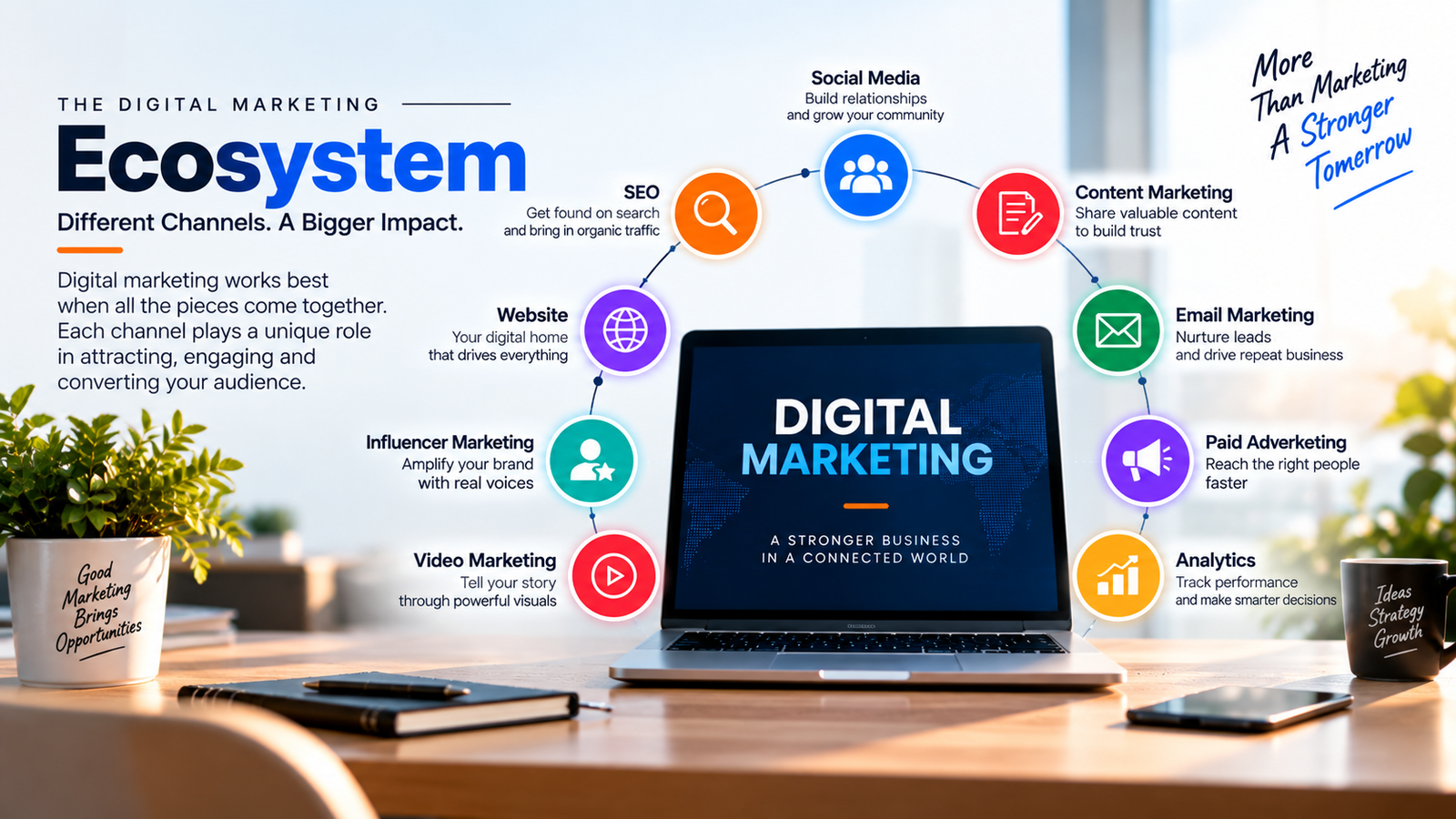
Digital marketing works best when channels are understood as parts of a connected ecosystem.
| Channel | Typical role |
|---|---|
| Website | Central destination for information, leads or sales |
| SEO | Improve organic search visibility |
| PPC / Paid Ads | Generate targeted paid traffic |
| Social Media | Awareness, engagement and community |
| Content Marketing | Educate, attract and build trust |
| Email Marketing | Nurture and retain audiences |
| Video Marketing | Explain, demonstrate and engage |
| Influencer Marketing | Reach audiences through creators |
| Mobile Marketing | Reach users through mobile experiences |
| Analytics | Measure performance and support decisions |
A single piece of content can contribute to several channels. For example, a useful article can rank in search, be shared on social media, attract website visitors, generate email subscribers and contribute to future conversions.
The ecosystem becomes more powerful when the channels are planned around a common objective rather than operated independently.
Major Digital Marketing Channels #
Search Engine Optimization (SEO) #
SEO focuses on improving a website’s visibility in unpaid search results. It includes technical optimisation, content, search intent, keywords, internal linking, authority and user experience.
Pay-Per-Click (PPC) #
PPC allows organisations to pay for advertising exposure or visits through platforms such as search, display, shopping and video advertising networks.
Social Media Marketing #
Social media marketing uses platforms such as Instagram, Facebook, LinkedIn and YouTube to publish content, engage audiences, build communities and support business objectives.
Content Marketing #
Content marketing involves creating and distributing useful, relevant content for a defined audience. Examples include articles, videos, guides, case studies, podcasts and infographics.
Email Marketing #
Email marketing enables organisations to communicate with people who have opted into their lists. Common uses include newsletters, welcome sequences, promotions, product updates and automated campaigns.
Website and Conversion Rate Optimization #
A website can act as the central destination where visitors learn, compare, enquire, register or purchase. Conversion Rate Optimization (CRO) focuses on improving the percentage of visitors who complete desired actions.
Analytics #
Analytics helps marketers understand acquisition, engagement, conversions, costs and other performance indicators so decisions can be based on evidence rather than assumptions.
Traditional Marketing vs Digital Marketing #
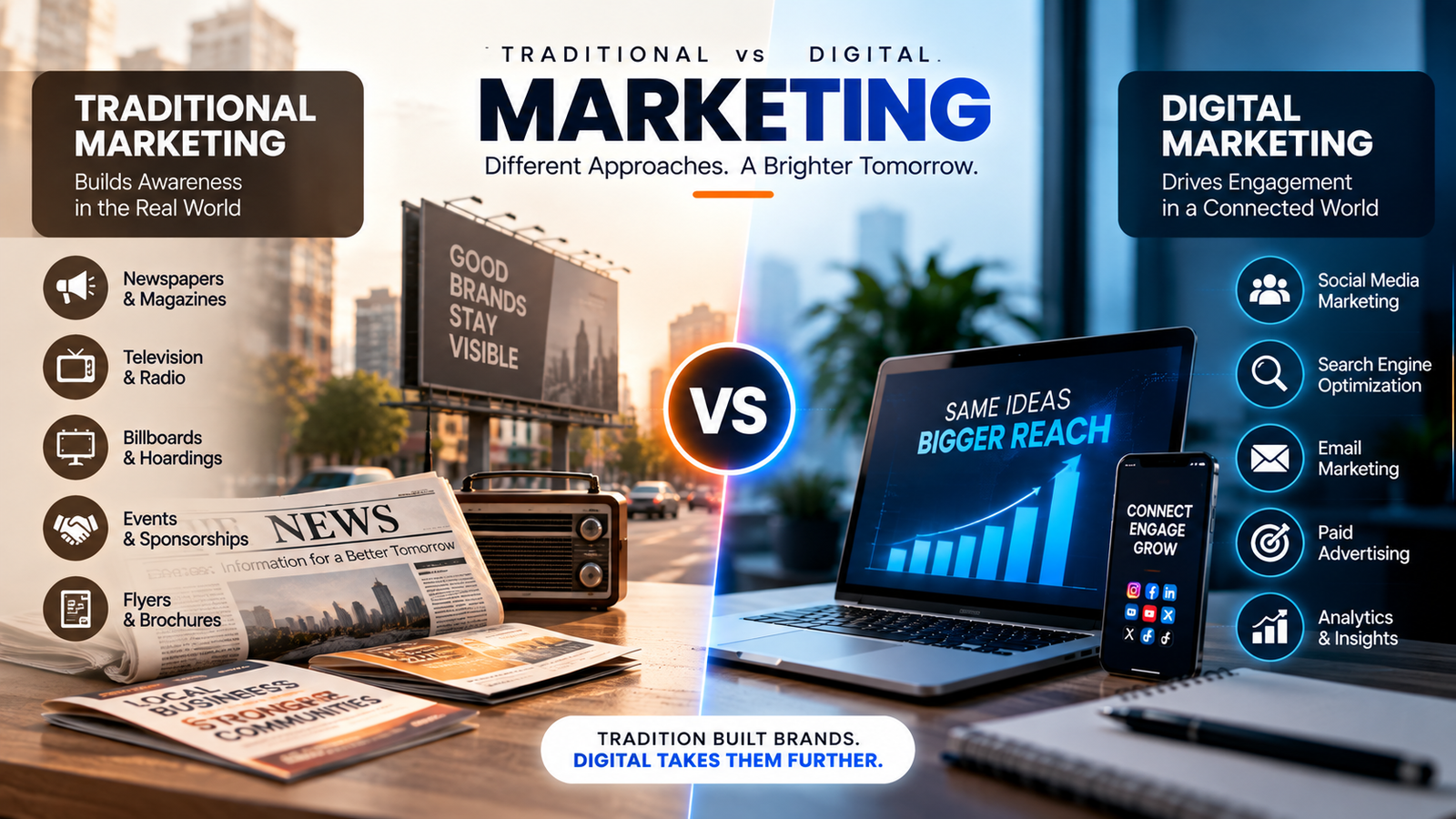
Traditional marketing includes channels such as television, radio, newspapers, magazines, billboards, direct mail and events.
Digital marketing includes websites, search engines, social media, email, online advertising, content platforms and mobile channels.
The comparison should not simply be viewed as old versus new. Both can have a role depending on the audience, objective, geography, product and budget.
Digital channels can provide detailed digital measurement, audience targeting, rapid feedback and opportunities for testing. Traditional channels can provide broad reach, physical presence and offline experiences.
A practical marketer therefore asks:
Which combination of channels can reach the intended audience and achieve the objective effectively?
How Digital Marketing Works #
A simplified digital marketing process is:
Research → Plan → Attract → Engage → Convert → Retain → Measure → Optimise
1. Research #
Understand the market, competitors, audience, customer needs, search behaviour and business environment.
2. Plan #
Define objectives, audience segments, positioning, channels, content, budget, KPIs and measurement methods.
3. Attract #
Use SEO, content, social media, advertising, referrals and other methods to bring relevant people into the marketing system.
4. Engage #
Provide useful information and meaningful experiences through content, websites, social interactions, email and other touchpoints.
5. Convert #
Make it easy for the audience to take the desired action—such as purchasing, booking, registering or submitting an enquiry.
6. Retain #
Continue the relationship through useful communication, customer service, content, email, loyalty initiatives and relevant offers.
7. Measure #
Track appropriate KPIs such as traffic, engagement, leads, conversion rate, customer acquisition cost and revenue-related metrics.
8. Optimise #
Use performance data and experiments to improve campaigns, content, landing pages, targeting, offers and customer experiences.
Digital Marketing Customer Journey #
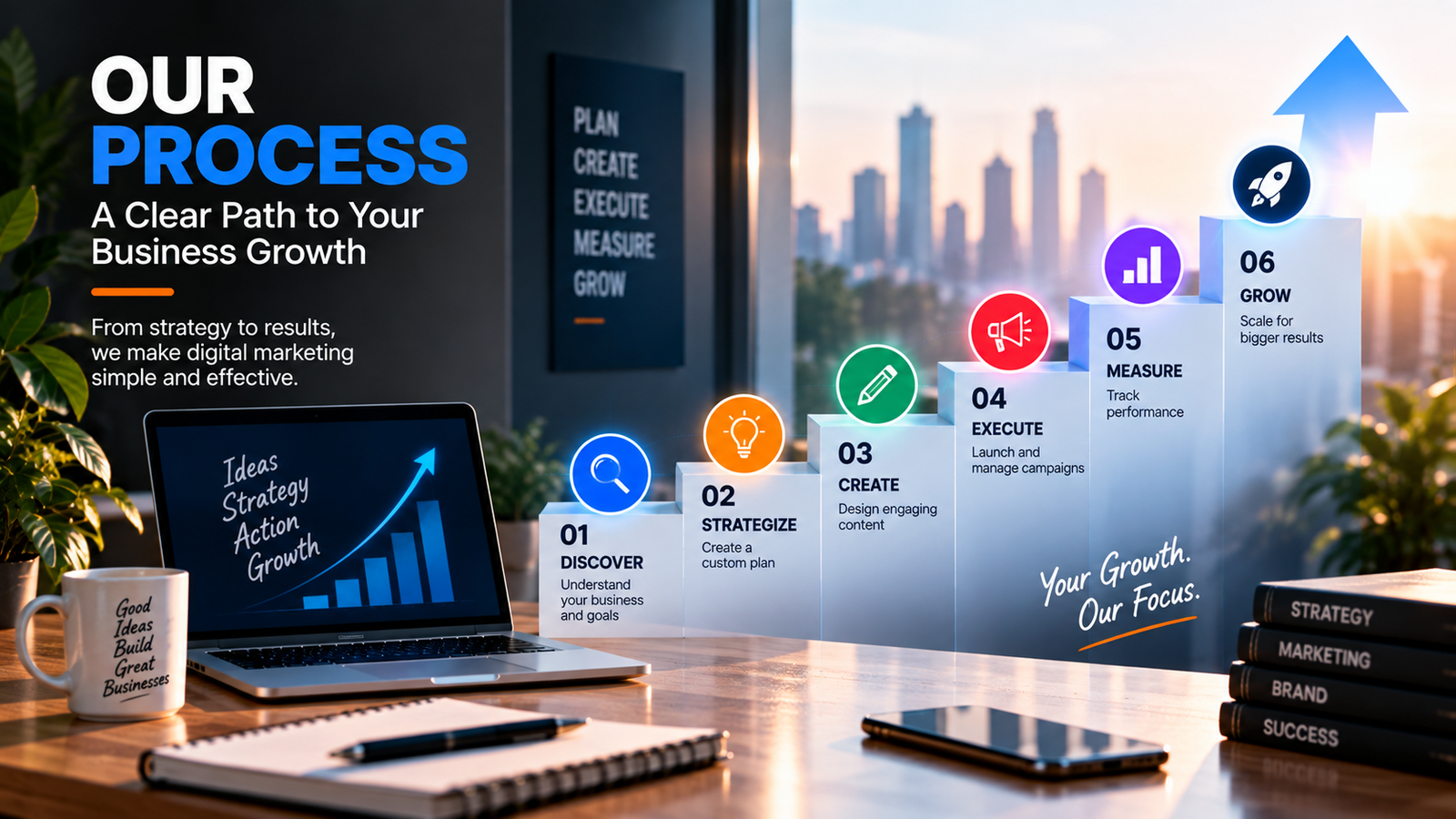
A customer rarely moves directly from first discovering a brand to becoming a loyal customer.
A simplified journey is:
Awareness → Consideration → Conversion → Retention → Advocacy
Awareness: The customer becomes aware of a need, problem, product or brand.
Consideration: The customer researches options, compares alternatives and evaluates whether the offer is suitable.
Conversion: The customer completes a desired action, such as purchasing, booking or submitting an enquiry.
Retention: The business continues providing value after the initial transaction or interaction.
Advocacy: A satisfied customer may recommend the business, leave a review or share the experience.
The journey is not always linear. People can repeat stages, move backward, interact with several channels or take weeks or months before converting.
Real-World Example: A Local Restaurant #
Consider a local restaurant launching a delivery service.
Objective #
Generate online orders from customers within its delivery area.
Audience #
People nearby who are interested in the restaurant’s cuisine and convenient food delivery.
Possible digital strategy #
Website: Create a mobile-friendly menu and ordering experience.
Local SEO: Improve local search visibility so nearby customers can discover the restaurant.
Social Media: Publish food photography, short videos, offers and customer experiences.
Paid Advertising: Run geographically targeted campaigns promoting the delivery service.
Content: Publish useful or entertaining content related to the restaurant and cuisine.
Email or Messaging: Communicate offers and updates to customers who have opted in.
Analytics: Measure visits, orders, conversion rate, advertising cost and revenue.
The lesson is important: the campaign is not simply an “Instagram campaign.” Each channel has a role, and the channels can work together around one business objective.
Digital Marketing Objectives #
Digital marketing activities should connect to measurable marketing or business objectives.
Common objectives include:
- Increase brand awareness
- Increase qualified website traffic
- Generate leads
- Increase online sales
- Increase bookings or enquiries
- Improve customer retention
- Increase repeat purchases
- Build a community
- Reduce customer acquisition cost
- Improve conversion rates
A useful objective is specific enough to guide action and measurement.
Weak: “Get more customers online.”
Stronger: “Generate 100 qualified enquiries from the target service area in 90 days.”
Important Metrics #
| Metric | What it measures |
|---|---|
| Impressions | How often content or an advertisement was displayed |
| Reach | Number of people/accounts exposed to content |
| Clicks | Traffic-generating interactions |
| CTR | Percentage of impressions that resulted in clicks |
| Conversion Rate | Percentage completing a desired action |
| CPC | Cost per click |
| CPA | Cost per acquisition/action |
| CAC | Cost of acquiring a customer |
| ROAS | Revenue attributed to advertising relative to ad spend |
| CLV | Estimated value generated by a customer over the relationship |
Metrics should not be viewed in isolation. Large traffic numbers do not automatically mean good performance if the visitors are irrelevant or the conversion experience is weak.
Owned, Earned and Paid Media #
Digital marketing is often organised into three media categories.
Owned media consists of digital properties controlled by the organisation, such as its website, blog, email list and branded content channels.
Paid media is exposure purchased through advertising, such as search ads, social ads, display ads or sponsored placements.
Earned media is exposure gained from others, such as reviews, shares, mentions, editorial coverage, recommendations and community discussion.
Strong campaigns can combine all three.
Advantages of Digital Marketing #
Digital marketing can provide:
- Access to audiences beyond a physical location
- Multiple channel options
- Detailed measurement
- Audience targeting opportunities
- Two-way interaction
- Rapid testing and optimisation
- Reusable content assets
- Opportunities to connect marketing activity with measurable actions
These advantages do not remove the need for strategy. Poor targeting, weak content, unclear offers or a poor website can still produce poor results.
Limitations and Challenges #
Digital marketing also involves challenges:
- Competition can be intense.
- Platforms and algorithms change.
- Privacy requirements affect data collection and targeting.
- Advertising costs can rise in competitive markets.
- Measurement can become complex across multiple channels.
- Large audiences do not necessarily mean relevant audiences.
- Businesses need appropriate skills, technology and processes.
- Poor-quality or misleading content can damage trust.
Successful digital marketing therefore requires continuous learning, testing and adaptation.
Common Mistakes #
Trying to Use Every Platform #
A business does not need to be active everywhere. Channel selection should follow the audience and objective.
Focusing Only on Followers #
Followers may be useful, but qualified traffic, leads, conversions, retention and revenue can be more directly connected to business objectives.
Ignoring the Website #
Social platforms can generate attention, but businesses should consider what happens after someone discovers the brand.
Creating Content Without Purpose #
Content should have a defined audience, purpose and relationship to the wider marketing strategy.
Measuring Vanity Metrics Alone #
Likes, impressions and follower counts can provide context, but they should not automatically be treated as business outcomes.
Failing to Test #
Digital marketing provides opportunities for experimentation. Marketers should test relevant variables and learn from the evidence.
Tools Used in Digital Marketing #
Common tool categories include:
- Search engine optimisation tools
- Web analytics platforms
- Search performance tools
- Advertising platforms
- Social media management tools
- Email marketing platforms
- Customer relationship management systems
- Content management systems
- Conversion and heatmap tools
- Reporting and dashboard tools
Tools should support a defined process. Having more tools does not automatically produce better marketing.
Practical Exercise #
Choose a real or imaginary business and create a one-page digital marketing outline.
- Define the business.
- Identify its target audience.
- Write one primary marketing objective.
- Select three digital channels.
- Explain the role of each channel.
- Define one KPI for each channel.
- Describe the customer journey from awareness to conversion.
- Suggest one method for measuring the campaign.
Example: A local fitness studio could target working adults within 8 km, use Local SEO, Instagram and Google Ads, and define consultation bookings as its primary conversion.
Interview and Exam Questions #
Beginner #
- What is digital marketing?
- How is digital marketing different from traditional marketing?
- What are the major digital marketing channels?
- What is a digital marketing KPI?
- What is a conversion?
- What is the difference between organic and paid marketing?
Intermediate #
- Explain the digital marketing ecosystem.
- How can SEO, content marketing and social media support each other?
- Explain the stages of a digital customer journey.
- What factors should a business consider when selecting digital channels?
- Explain owned, earned and paid media.
- Why is measurement important in digital marketing?
Practical Case #
A local service business receives many website visitors but very few enquiries. What would you investigate?
Consider traffic quality, search intent, landing-page relevance, page speed, mobile usability, trust signals, calls to action, form usability, offer clarity and analytics data before recommending changes.
Quick Revision #
- Digital marketing uses digital channels, technologies and data to achieve marketing objectives.
- It is much broader than social media.
- Major areas include SEO, PPC, social media, content, email, websites, CRO and analytics.
- Digital channels can work together as an ecosystem.
- Customer journeys can include awareness, consideration, conversion, retention and advocacy.
- Objectives should connect to measurable KPIs.
- Analytics helps marketers understand performance and improve decisions.
- Digital marketing requires continuous testing and optimisation.
- The appropriate channel mix depends on the audience, objective, market and resources.
Related Topics / Next Lessons #
Continue the Fundamentals path with:
- Need & Scope of Digital Marketing
- Traditional Marketing vs Digital Marketing
- Evolution of Digital Marketing
- Digital Marketing Ecosystem
- Components of Digital Marketing
- Digital Marketing Channels
- Digital Marketing Platforms
- Owned, Earned & Paid Media
Key Takeaway #
Digital marketing is best understood as a connected marketing system, not a collection of individual platforms.
The objective is to understand the audience, choose appropriate channels, create useful experiences, guide people toward meaningful actions, measure what happens and continuously improve the system. Once this foundation is clear, disciplines such as SEO, PPC, social media, content, email, analytics and CRO become easier to understand because you can see where each one fits into the larger marketing process.


